About PDDC
Why Image Captioning for Plant Diseases?
Agriculture is crucial to a nation's economy, directly impacting food security and the quality of life. Major staple crops such as rice, wheat, and maize account for over 60% of global caloric intake, with rice being the primary food source for more than half of the world's population, producing approximately 760 million tons annually. These crops are susceptible to diseases, which can cause yield losses of up to 40% in severe cases. For instance, wheat rust disease results in global losses exceeding $2.9 billion annually. Therefore, the rapid and accurate diagnosis of crop pathological symptoms is vital for ensuring food security and improving living standards.
Just as in human medicine, where doctors rely on comprehensive analysis of various patient examination data to make precise diagnoses, agricultural production also requires such precision. Agricultural experts assess potential diseases affecting crops based on symptoms such as color, shape, and texture. Timely disease diagnosis helps farmers implement effective prevention and control measures, ensuring healthy crop growth and safeguarding the quality and yield of agricultural products. As shown in Figure 1.
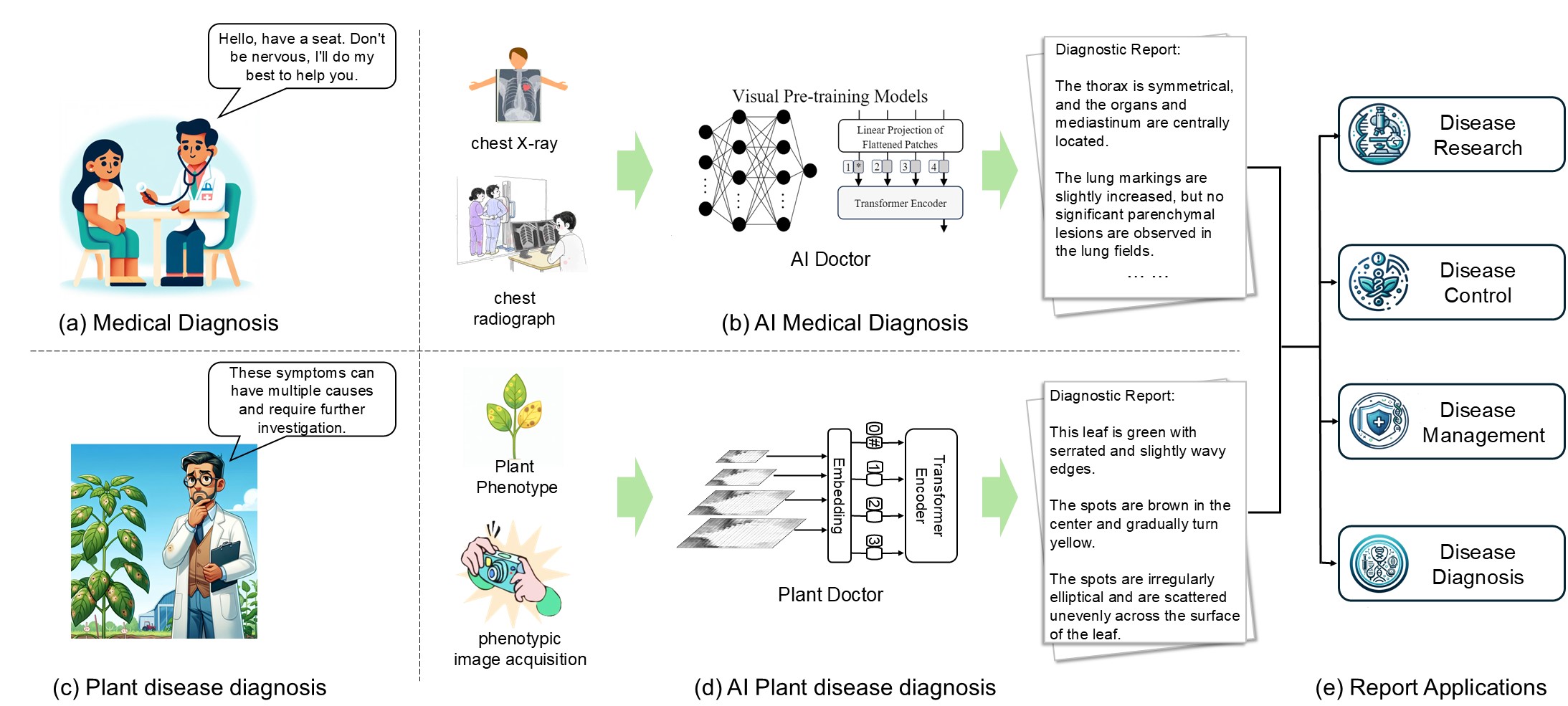
Figure 1: The diagram demonstrates the application of multimodal learning models, initially used in human healthcare, now extended to plant disease diagnosis.
Challenges in Plant Disease Caption
The current methods for plant disease image description focus on accurately depicting the phenotypic characteristics of specific plant diseases. They leverage the capabilities of transformer models, utilizing their unique attention mechanisms to learn and capture the specific features of plant diseases. However, existing methods often encounter several issues that hinder the progress of this field. Firstly, the generated descriptive text tends to be overly simplistic, failing to accurately capture the phenotypic characteristics of plant diseases. Secondly, current methods rely on attention mechanisms to learn plant disease features, causing the model to often focus solely on prominent, easily identifiable features in images, while neglecting equally important but less obvious secondary features. This biased focus leads to poor performance when identifying complex diseases or early-stage symptoms, limiting their potential applications in early warning and precise diagnosis. Additionally, since existing methods primarily rely on disease data from specific plants for training, the generalization ability of the models is weak.
why PDPC?
To address the issues present in existing methods, we have introduced an innovative image description framework called PDPC, specifically designed to tackle the problems of overly simplistic descriptions, neglect of local features, and poor generalization in current plant disease image description methods. The PDPC framework enhances the semantic richness and precision of descriptions by utilizing a caption corpus and syntactic analysis techniques, ensuring comprehensive and accurate descriptions of plant diseases. This approach not only improves the focus on secondary features but also demonstrates good generalization potential across a wide range of plant diseases, making it versatile.
Research Team
SAMLab